The cordless tool market is crowded with lookalike promises, but every so often a model arrives that reveals where the category is actually headed. The Makita XMT04ZB is one of those tools. What interests me most is not simply that it cuts, sands, and trims, but that it reflects a larger shift in how professionals now judge value: not by raw power alone, but by how quickly a tool disappears into the workflow.
That is the real test on a flooring crew, in a finish carpenter’s truck, or on a remodeling site where time is eaten up by adjustment cuts, jamb trimming, vent openings, and last-minute corrections. In that world, a cordless oscillating tool is no longer a convenience item. It is a precision instrument. And the Makita XMT04ZB makes a compelling case for why the best tools today are the ones that eliminate friction before the operator even notices it.
Why Cordless Oscillating Tools Have Become Essential
For years, oscillating tools occupied an odd place in the power-tool hierarchy. They were useful, sometimes indispensable, yet rarely considered central to a professional kit. That has changed. On contemporary job sites, the ability to make a controlled plunge cut, shave a door jamb, or trim material flush without hauling out a larger saw is no longer a niche advantage. It is part of the baseline expectation for efficient work.
That shift helps explain why the Makita XMT04ZB deserves attention. It lands in a category where speed is important, but control is everything. Flooring installers, trim carpenters, cabinet fitters, and punch-list specialists do not need drama from a multi-tool. They need predictability. They need clean entry cuts, fast accessory swaps, and enough stability to work close to visible surfaces without turning a minor adjustment into a repair job.
From that perspective, this tool’s appeal is straightforward. It is built around the kind of practical problem-solving that separates a serious cordless platform from a generic one. It is meant to save motions, save setup time, and save the operator from having to fight the tool when the cut needs to be exact.
The Feature Set That Actually Matters
There is a temptation in tool coverage to obsess over feature lists, but most professionals already know the difference between meaningful innovation and brochure filler. In the Makita XMT04ZB, the features worth discussing are the ones that translate directly to the pace of the day.
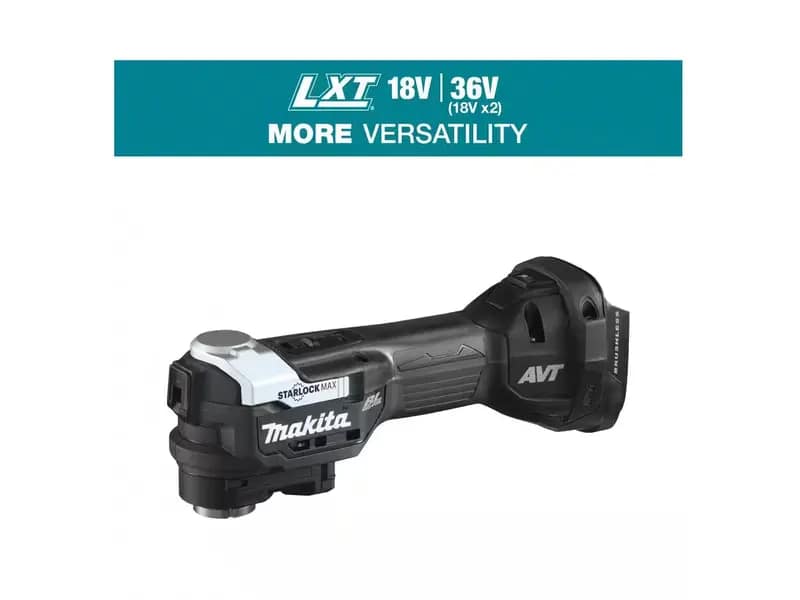
The first is StarlockMax compatibility, which matters because accessory fit is not a trivial detail. It affects torque transfer, cut stability, and the overall sense of confidence the user gets from the machine. A better interface between tool and blade does more than improve efficiency. It reduces the slight chatter and uncertainty that often show up when a tool is pushed into dense material or awkward positions. For anyone who spends long hours making repetitive cuts, that refinement is not cosmetic. It is cumulative.
The second is the tool-free blade-change system. I do not regard quick-change hardware as a luxury on a multi-tool. I see it as one of the defining factors that determines whether a tool keeps pace with a professional workflow. The operator who shifts from plunge cutting to flush cutting to sanding does not want accessories to become a mini-project. Fast swaps preserve momentum, and momentum is what keeps labor productive.
The third is Makita’s broader reputation for ergonomics and platform discipline. This is where the Makita XMT04ZB enters a more sophisticated conversation. Many cordless tools perform well enough on isolated cuts. Far fewer remain comfortable, balanced, and intuitive through the kind of stop-and-start use that defines real field work. A good oscillating tool has to feel secure in cramped positions and controllable when the material resists. That difference shows up not in the first five minutes, but in the fifth hour.
Where The Makita XMT04ZB Makes The Most Sense
I would not position the Makita XMT04ZB as a universal answer for every buyer. The stronger argument is that it fits a very specific and increasingly common kind of professional use. This is the tool for the installer who values precision over spectacle and wants cordless mobility without giving up the confidence of a more mature accessory system.
Hardwood flooring is one of the clearest examples. A flooring installer may rely on a dedicated nailer or saw for the main production work, but the oscillating multi-tool is what resolves the details that determine whether the finished room looks deliberate or improvised. Door casings need to be undercut cleanly. Registers need neat openings. Edge pieces need slight corrections without splintering visible material. These are not glamour cuts, but they are the cuts that clients notice when they are done poorly.
The same logic applies in remodeling. One of the reasons oscillating tools have grown in importance is that renovation work is rarely neat or repetitive. Walls are out of square. Existing trim is inconsistent. Materials overlap in inconvenient ways. In those environments, the Makita XMT04ZB is attractive because it appears designed for the small, exact, high-consequence tasks that larger tools handle clumsily.
It is also a rational choice for users already invested in Makita’s battery ecosystem. That is not a minor point in 2026. The platform has become part of the purchase decision in nearly every professional trade. A great stand-alone tool can still lose out if it adds charger clutter, battery fragmentation, and unnecessary complexity to the truck. For contractors who already run Makita gear, the XMT04ZB has an easier case to make.
The Competitive Reality
No serious assessment would ignore the fact that this is a fiercely contested segment. Milwaukee, DeWalt, Bosch, and FEIN all have credible claims in cordless oscillating tools, and each appeals to a slightly different buyer. Some emphasize aggressive cutting speed. Others lean into premium accessory systems or site-ready durability. In that context, the Makita XMT04ZB does not need to dominate every metric to matter.
What gives it editorial relevance is that it appears to understand the current market better than many tools that shout louder. Buyers in this category are not merely shopping for another cordless gadget. They are buying into a philosophy of work. They want a tool that starts fast, cuts cleanly, changes accessories without fuss, and integrates into the rhythm of professional labor. That is the standard now.
The Makita XMT04ZB is therefore important not because it reinvents the oscillating tool, but because it represents the maturing of the category. It signals that the market is rewarding refinement, not just brute capability. That is good news for professionals, because refinement is what turns a tool from something you own into something you reach for instinctively.
In the end, that is why this model matters now. The jobs are moving faster, labor remains expensive, and finishing details increasingly define whether work feels premium or rushed. The Makita XMT04ZB speaks directly to that reality. It is a reminder that in modern construction and remodeling, the smartest cordless tools are not the loudest or the flashiest. They are the ones that make precise work feel routine.