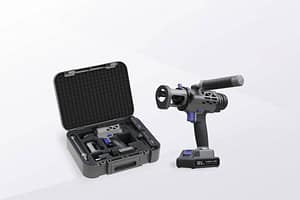
Do you remember when “cordless” meant a weak drill that stopped working too soon? Those times are gone. We’re seeing a big change, not just a small update.
The old ways of using wall outlets and gas cans are being replaced. The real leaders in this change are the power packs, not the tools themselves.
Let’s dive into the science behind this change. The key player is the lithium-ion cell. It has become more powerful, lighter, and charges faster. This has changed what power tools can do.
This change is big and growing fast. The market is expected to jump from $39.5 billion to $45.5 billion in five years. Why? Because “battery-powered” now means powerful and capable.
But what’s next? Even lithium-ion is facing a challenge from its own new versions. The search for even more power is on. The days of corded tools are ending. Now, we wonder what will take their place?
Current State of Power Tool Battery Technology
The cordless revolution didn’t happen overnight. It was a slow coup where lithium-ion batteries quietly deposed their nickel-cadmium predecessors. Think of it as a political uprising in your toolbox. The old nickel-cadmium regime was bulky, temperamental, and environmentally questionable. Lithium-ion swept in with promises of a better tomorrow. Today, it’s the undisputed standard, but like any long-serving administration, it’s showing its age.
Let’s rewind to the battle that shaped our current reality. Nickel-cadmium batteries were the workhorses of the 90s. They were reliable in a brutish way, like a fax machine or dial-up internet. But they suffered from what engineers call the “memory effect.” If you didn’t fully discharge them before recharging, they’d forget their full capacity. It was battery amnesia, and it drove users mad.
Lithium-ion innovations changed everything. The advantages weren’t subtle; they were revolutionary. First, the energy density. You could pack more power into a smaller, lighter package. A modern 18V lithium-ion battery pack weighs half what its NiCd ancestor did but delivers more consistent voltage. That means your drill feels like a tool, not a wrist weight.
Second, the death of the memory effect. With lithium-ion battery chemistry, you can top up the charge anytime without guilt. Need five more minutes of runtime? Plug it in for ten. This freedom transformed how we work. No more planning your day around battery discharge cycles.
Third, speed. Lithium-ion cells charge significantly faster. What took an hour for NiCd now takes 30 minutes or less with fast chargers. This isn’t just convenient; it changes job site logistics. Fewer batteries, less downtime, more productivity.
Lastly, the environmental pitch. Nickel-cadmium contains toxic cadmium, a heavy metal with serious disposal issues. Lithium-ion batteries, while not perfect, use less toxic materials. It was an easy win for marketing departments everywhere.
But here’s where our charming revolutionary reveals its flaws. This technological plateau comes with three significant caveats: cost, lifespan, and temperament.
Cost remains the entry barrier. Lithium-ion battery packs are more expensive to manufacture. You’re paying for advanced battery chemistry and the sophisticated electronics needed to manage it. That premium gets passed to you at the checkout.
Lifespan is the dirty secret. These batteries have a biological clock. Most are rated for 300-500 full charge cycles or 2-5 years of typical use. After that, capacity drops noticeably. Your once-mighty battery becomes a shadow of its former self. It’s planned obsolescence by chemistry.
Temperament is the real drama. Lithium-ion cells are divas. They hate extreme heat and cold. More critically, they’re prone to thermal runaway—a chain reaction that can lead to fire or explosion. This isn’t theoretical; it’s why airlines have strict rules about them.
This vulnerability birthed an entire ecosystem of guardians: the Battery Management System (BMS). This tiny computer lives inside your battery pack, constantly monitoring voltage, temperature, and current. It’s the chaperone at the party, making sure no cell gets overworked, overcharged, or overheated. Without BMS, lithium-ion would be too dangerous for consumer tools.
| Feature | Nickel-Cadmium (NiCd) | Lithium-ion (Li-ion) | Practical Impact |
|---|---|---|---|
| Energy Density | Low (50-80 Wh/kg) | High (100-265 Wh/kg) | Lighter tools, longer runtime |
| Memory Effect | Yes, significant | None | Charge anytime without capacity loss |
| Charging Speed | Slow (1-2 hours typical) | Fast (30-60 minutes typical) | Less downtime on job sites |
| Environmental Impact | Contains toxic cadmium | Less toxic, but mining concerns | Easier disposal, but not perfect |
| Cost | Lower initial cost | Higher initial cost | Higher upfront, better value over time |
| Lifespan | Long (1000+ cycles) | Medium (300-500 cycles) | More frequent replacements needed |
So where does this leave us in 2024? We’re camped on a comfortable plateau. Every major brand—DeWalt, Milwaukee, Makita—has built their entire cordless empire on this lithium-ion foundation. The ecosystem is mature: tools, chargers, and battery platforms are standardized. It works well enough that most users never question it.
But that plateau has cracks. The finite lifespan means you’re buying new batteries every few years. The cost keeps premium tools out of some budgets. And the safety concerns mean every battery pack needs its electronic babysitter.
The current state of power tool battery technology is one of optimized compromise. We’ve traded the brutish reliability of nickel-cadmium for the sleek, high-performance fragility of lithium-ion. It’s like choosing a smartphone over a landline: infinitely more capable, but you’d better not drop it in water.
This isn’t the end of the story. It’s merely the second act. The limitations of current lithium-ion innovations are the very reasons researchers are scrambling up the next cliff face. They’re looking at solid-state designs, graphene enhancements, and silicon anodes—all attempts to fix what’s broken while keeping what works.
For now, we live in the lithium-ion age. It powers our drills, our saws, and our aspirations for a truly cordless future. Just remember to thank the BMS for keeping the revolution from literally catching fire.
Solid-State Battery Breakthrough Analysis
The excitement around solid-state batteries is huge, but is the real deal ready yet? This is one of the most exciting Battery Technology Advances coming our way. Let’s look at the promise and the timeline.
It’s a simple idea. Current lithium-ion batteries use a liquid that can catch fire. Solid-state batteries replace this with a solid material. It’s like switching from a flammable gel to a safe, solid brick.
The benefits are huge. First, safety. No more worries about batteries catching fire. Second, energy density. A solid material could double the runtime of tools and make batteries smaller.
Imagine a cordless saw that lasts all day, with a battery that’s half the weight and safe. It’s a dream for pros. But, we need to be realistic.
By 2024, this is mostly a dream for power tools. The science is good, but making these batteries is very expensive. Scaling up production to meet demand is a huge challenge.
So, what’s the future? The table below shows the difference between today’s batteries and the promise of solid-state ones.
| Feature | Current Lithium-Ion | Solid-State Promise |
|---|---|---|
| Electrolyte | Flammable Liquid | Solid Ceramic/Polymer |
| Key Safety Risk | Thermal Runaway & Fire | Extremely Low |
| Energy Density | Good (Baseline) | Excellent (Could be 2x) |
| Manufacturing Cost | Low & Optimized | Extremely High |
| Market Readiness for Tools | Industry Standard | R&D / Prototype Stage |
The big question is not if solid-state batteries are better. It’s when they’ll be ready for your tools. Will they be the standard in a decade, or just a future dream?
I think we’ll see these Battery Technology Advances first in electric cars and high-end gadgets. For power tools, it will take time. Solid-state batteries might show up in top tools by the late 2020s. But for everyone else, it will take longer. The breakthrough is real, but your next battery won’t be one.
Graphene-Enhanced Battery Performance
Remember when graphene was going to give us space elevators? Now, it’s making your power tools charge faster than you can make coffee.
This “miracle material” is a single layer of carbon atoms in a honeycomb lattice. It brings two superpowers to battery chemistry. First, it’s incredibly electrically conductive. Second, it manages heat exceptionally well. It’s like upgrading your battery’s internal wiring to Formula 1 standards.

On the job site, traditional lithium-ion cells have limits. They get hot, performance drops, and charging slows. Graphene technology changes this.
Graphene acts as a microscopic heat sink and electron highway. Electrons zip along with minimal resistance. Heat dissipates efficiently. This enables what professionals need:
- Blistering fast charging: We’re talking minutes, not hours. A battery that charges during your lunch break.
- Sustained high-power output: No more voltage sag when your saw hits dense material.
- Cooler operation: Extended runtime without thermal shutdowns.
The Milwaukee MX FUEL concrete saw running cordless? That’s graphene technology at work. The battery delivers brutal, sustained power without overheating.
Here’s the clever part: we’re not using pure graphene batteries yet. That’s in the lab. Current battery chemistry uses graphene as an enhancement. It’s like adding a turbocharger to an already good engine.
Manufacturers add graphene to anodes, cathodes, or as conductive additives. This tweaks the battery chemistry at the molecular level. The result? Batteries that can handle the insane power demands of modern cordless tools.
So while graphene might not build our space elevators anytime soon, it’s already changing how we build everything else. Your power tools just got an upgrade they didn’t know they needed.
Silicon Nanowire Anode Innovations
Imagine a material that could store ten times more energy but swells so much it destroys itself. This is the silicon anode dilemma. It’s a promising lithium-ion innovation but faces a “structural challenge.”
Graphite has been the reliable but boring choice for battery anodes for decades. It’s stable and predictable but not exciting. Silicon, on the other hand, can store about ten times more lithium ions. The problem is it swells up to 300% during charging.
This swelling isn’t just inconvenient; it’s catastrophic. Each charge-discharge cycle creates microscopic cracks that eventually cause complete failure. Your power tool battery doesn’t just lose capacity; it tears itself apart from the inside. This has been the biggest roadblock in Battery Technology Advances for mobile applications.
Enter the nanowire. Researchers create forests of microscopic silicon wires instead of solid blocks. It’s like giving silicon room to breathe. Each nanowire has space to expand laterally without crushing its neighbors. It’s an architectural solution to a chemical problem.
The beauty of this approach lies in its simplicity. By structuring the silicon at the nanoscale, we’re not fighting physics – we’re working with it. These flexible wires can swell and contract without developing the stress fractures that doom conventional silicon anodes. This represents a genuine breakthrough in lithium-ion innovations.
For power tool users, the implications are profound. We’re talking about batteries that could last years instead of months between replacements. The cycle life – that critical number of charges before performance drops – could see improvements measured in multiples.
This isn’t just another incremental tweak. It’s a fundamental reimagining of how we build energy storage from the ground up. When silicon nanowire technology matures and becomes cost-effective, it will represent one of the most significant Battery Technology Advances in recent memory.
The annual battery replacement budget for contractors and DIY enthusiasts could become a thing of the past. More importantly, we’d be getting significantly more work done between charges. That’s the real promise of these nano-scale architectural solutions.
Lithium-Metal vs Lithium-Ion Comparison
Imagine lithium-ion as a well-organized apartment complex for energy. Lithium-metal is like the wild, untamed wilderness of pure electrochemical power. This isn’t just a small difference—it’s a big split in how we store energy. One technology sticks with what’s known and safe. The other takes a risk on raw, unadulterated power.
The main difference is at the anode, the negative terminal where the magic happens. Today’s lithium-ion innovations use graphite or silicon compounds. These materials don’t have pure lithium metal. Instead, they offer structured “apartments” for lithium ions to move in and out during charging.
Lithium-metal technology is different. It uses pure, elemental lithium metal as the anode. This is the dream material scientists have wanted for decades. It’s like owning the property, not just renting space.
The energy density numbers show a big difference. Lithium-metal anodes could offer 3,860 mAh/g. This is much higher than graphite’s 372 mAh/g. This means power tools could run twice as long without needing bigger batteries.
But there’s a catch. Lithium metal can form spiky, tree-like structures called dendrites during charging. These can grow through the separator membrane and touch the cathode. This can cause an internal short circuit.
This can lead to fires and safety concerns. It’s a high-risk, high-reward situation. Research on battery safety advancements shows dendrite formation is the main challenge for lithium-metal batteries.
| Feature | Lithium-Ion Technology | Lithium-Metal Technology |
|---|---|---|
| Anode Material | Graphite or Silicon Compounds | Pure Lithium Metal |
| Energy Density | 150-250 Wh/kg (current) | 500+ Wh/kg (theoretical) |
| Safety Profile | Established, managed risks | Dendrite formation challenges |
| Commercial Status | Mature, widespread adoption | Laboratory & prototype stage |
| Charging Behavior | Controlled ion intercalation | Uneven metal plating risks |
Solid-state batteries could be the solution. They replace the flammable liquid electrolyte with a solid material. This solid material might block dendrites from growing.
Think of it as installing a bulletproof wall between neighbors. If solid-state batteries can make lithium-metal anodes safe, we get the best of both worlds. We get high energy density and safety.
So, which technology wins? The answer might be “both, eventually.” Lithium-ion isn’t going away soon. Its lithium-ion innovations keep improving power tools. But for a big leap, like a tool that lasts all week, lithium-metal and solid-state tech are the future.
The real competition isn’t lithium-metal versus lithium-ion. It’s about making things better versus starting over. In power tools, where safety and performance matter, we need both.
Temperature Performance Improvements
A battery that can’t handle cold Minnesota winters or hot Arizona summers is useless. Power tools face extreme temperatures, not lab conditions. The latest advancements aim to eliminate environmental excuses.
Old NiCd batteries were terrible in the cold, losing power fast. Lithium-ion was better but could be temperamental. Now, batteries can thrive in extreme temperatures.
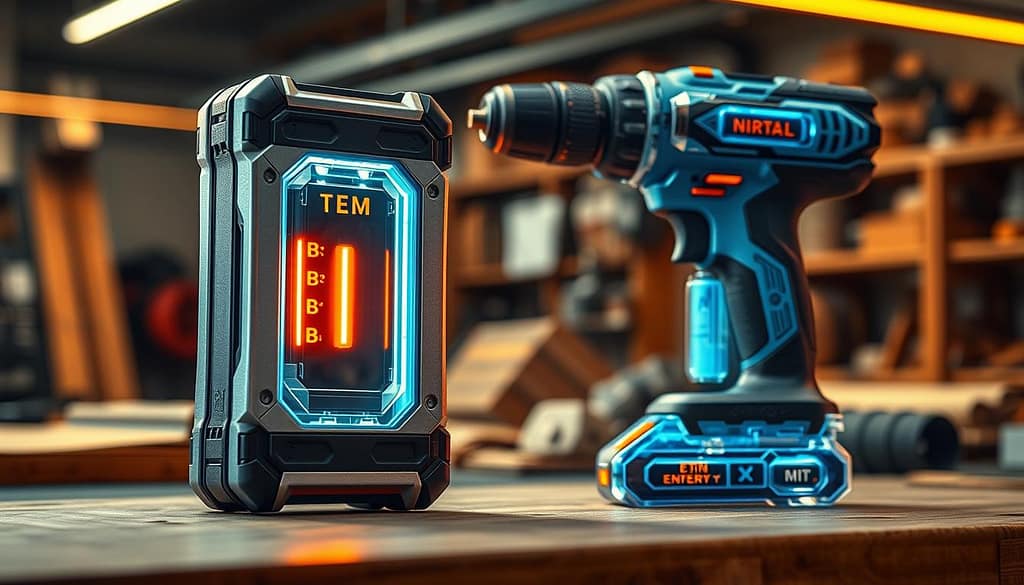
The key is smarter brains and tougher chemistry. The Battery Management System (BMS) now controls temperature. It warms up cold cells and cools hot ones.
This technology is essential for outdoor tools and vehicles. It prevents failures due to temperature, saving time and money. A smart BMS keeps equipment running smoothly.
Graphene technology also plays a big role. It’s great at conducting heat, keeping batteries cool under load and warm in the cold. This ensures consistent performance.
New battery materials are also more temperature-tolerant. We’re moving towards batteries that work well from -20°F to 120°F. This makes tools reliable and easy to use.
| Battery Technology | Optimal Temp Range | Cold Weather Capacity Retention | BMS Thermal Regulation | Best Application |
|---|---|---|---|---|
| Nickel-Cadmium (NiCd) | 50°F – 86°F | ~40% at 32°F | None | Indoor, Mild Climate Use |
| Standard Lithium-Ion | 32°F – 113°F | ~70% at 32°F | Basic Protection | General Purpose Tools |
| Advanced Li-ion with Graphene | -4°F – 140°F | ~85% at 32°F | Active Heating/Cooling | Professional Outdoor Equipment |
| Next-Gen Solid-State (Emerging) | -40°F – 158°F (Projected) | ~90%+ at 32°F (Projected) | Integrated Adaptive System | Extreme Environment & Military |
The table shows our progress. We’ve moved from batteries that barely work outside to ones designed for real-world use. This is what sets professional equipment apart.
The goal is to make batteries work in any environment. Contractors in Denver shouldn’t worry about the weather. With these improvements, they don’t have to. This is a revolution in reliability.
Cycle Life Extension Technologies
The worst part of DIY isn’t cutting a board too short. It’s when your cordless drill’s battery dies after 18 months. This limited life makes every tool purchase feel short-lived. But what if we could make batteries last longer?
The latest Battery Technology Advances aim to do just that. They’re not just about more power. They’re about making cells that last longer.
Think of a battery’s cycle life as its soul. Each charge and discharge is like a birth and death. Traditional cells are like boxers taking punches every round. New approaches turn them into tactical martial artists, minimizing damage with each move. This shift represents the most practical of lithium-ion innovations.
The battle begins at the molecular level. Cathode coatings act like microscopic body armor. These ultra-thin layers protect the cathode from corrosive reactions during charging. It’s like sunscreen for your battery’s most vulnerable organ.
Without this protection, cathodes degrade like paper in the rain.
Electrolyte additives work as chemical peacekeepers. They form stable interfaces between electrodes and electrolytes, preventing destructive byproducts. Imagine adding stabilizers to gasoline that keep your engine clean for 200,000 miles. These additives are the unsung heroes of cycle life extension.
The real brainpower comes from advanced Battery Management Systems. Modern BMS algorithms are like hyper-vigilant personal trainers. They precisely manage charge states, avoiding stress zones at very high or low charges. They learn your usage patterns and optimize charging strategies.
These systems don’t just count cycles—they analyze how each cycle affects the battery. They might charge to only 90% for daily use, saving the full 100% for when you really need it. This intelligent throttling can double a battery’s useful life without sacrificing performance.
The implications are enormous. When batteries become semi-permanent components, the total cost of ownership plummets. Professional contractors could use the same battery pack across multiple tool generations. Home users might never need to replace their drill’s power source.
This represents a fundamental Battery Technology Advance with environmental teeth. Fewer dead batteries mean less e-waste. The economics shift from planned obsolescence to engineered permanence. Your tool’s heart keeps beating season after season, project after project.
The ultimate goal? Making the battery pack as durable as the tool itself. Through cathode armor, chemical additives, and brilliant software, we’re closing in on that reality. The next generation of lithium-ion innovations promises not just more runtime, but more life.
Environmental Impact of New Battery Tech
When I hear ‘green battery,’ I think of lithium mines. I wonder if we’re just swapping one environmental problem for another. The marketing might make it seem like we’ve fixed everything. But the real story is more complex.
New battery types are making progress. Solid-state batteries often cut out cobalt, which is a big deal. Cobalt mining harms people and the environment.
Graphene technology is also a step forward. It’s made from sustainable carbon and doesn’t carry the same heavy metal risks. These advancements are not just about numbers. They’re about doing the right thing.
But there’s a catch. Lithium mining is water-intensive and changes landscapes. Modern batteries are better than old ones, but that’s not saying much. It’s like saying you’re better off using natural gas than coal.
Long-lasting batteries are the real winners. A battery that lasts longer means less resource use over time. Fewer batteries need to be mined, made, shipped, and thrown away. That’s a big reduction in environmental impact.
Recycling is also key. Batteries with simpler chemistries are easier to recycle. This turns a linear system into a circular one. The path to sustainability involves this kind of full lifecycle analysis.
We’re cautiously hopeful. The industry is moving forward, thanks to rules, experts, and a sense of responsibility. The next generation of solid-state batteries and graphene technology is about smarter, cleaner energy.
We’re not aiming for a completely green battery yet. That’s not possible. But we’re working towards better batteries. Less harm per watt-hour. Longer life per gram of material. That’s a change worth making.
Future Battery Technologies in Development
What’s next? We’re not just tweaking old ideas. We’re diving into new battery chemistry. Solid-state batteries and graphene tech are just the start.
Research labs are exploring wild ideas. Think lithium-sulfur for super high energy density. Or sodium-ion for cheap, common materials. Even structural batteries where the tool itself is the battery.
These ideas aren’t just for show. They’re for real-world applications that sound like science fiction. Electric vertical takeoff aircraft need light batteries. Humanoid robots and delivery bots need to last long.
Your smart home will need a smart power grid. This future changes the cordless dream. Your drill won’t just have a battery; it’ll have a smart partner.
Imagine Bluetooth modules checking battery health or materials that fix themselves. This is the next step in lithium-ion tech.
The battery is becoming more than just a part. It’s the key to everything that moves, builds, or thinks. Get ready. The next big change is coming, powered by a single cell.