The difference between an average finish and a premium one is often decided long before stain, sealer, or topcoat enters the picture. Right now, as woodworking shops and floor refinishing crews face tighter deadlines and higher client expectations, pneumatic sanders are re-emerging as one of the most practical tools for producing cleaner surfaces with less operator strain.
I have come to see this not as a nostalgic return to older equipment, but as a clear-eyed reassessment of what actually works on demanding jobs. When surface quality matters and fatigue becomes a production issue, lighter air-powered sanding tools make a compelling case.
Why Pneumatic Sanders Are Back in Focus
In many professional environments, sanding is the most deceptively important stage of the entire finishing process. It does not carry the drama of cutting or assembly, but it determines how the final surface will read under light, finish, and close inspection. If the prep work is uneven, every later step becomes an attempt to disguise a flaw that should have been solved earlier.
That is where pneumatic sanders stand out. Because they are powered by compressed air rather than a built-in electric motor, they are often lighter in the hand and easier to guide through long work sessions. That reduction in weight may sound minor on paper, but over the course of a day, it changes how a tool behaves in real use. A lighter machine is easier to control, easier to feather at edges, and less punishing on wrists and shoulders.
In practical terms, that translates into better consistency. When an operator is less fatigued, pressure stays more even, movement becomes more controlled, and the likelihood of visible sanding errors drops. In woodworking and flooring alike, that reliability is more valuable than any single feature on a product sheet.
Understanding the Two Main Types
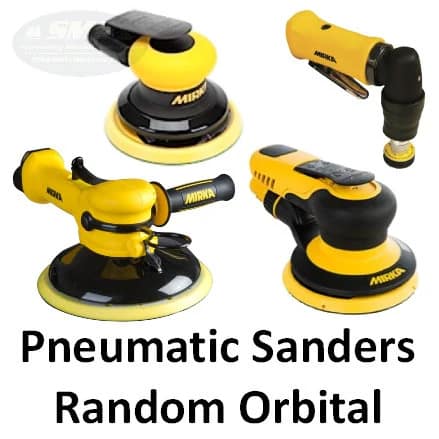
Not all sanding work asks for the same kind of aggression or finesse. Pneumatic sanders are most useful when professionals choose the right format for the specific stage of the job. The two most relevant categories are random orbital sanders and belt sanders, and each serves a distinct purpose.
Random orbital models are best suited to finish preparation. Their movement helps reduce visible sanding patterns, making them the preferred option when the goal is a smooth, refined surface. For cabinetry, trim, panel work, and final prep on hardwood surfaces, they offer the kind of controlled abrasion that leaves the wood ready for finishing rather than merely stripped down.
Belt sanders occupy a different role. These are the workhorses for aggressive material removal. When a surface needs to be leveled, an old finish needs to come off quickly, or a board requires significant correction, a belt sander is the more efficient choice. It sacrifices delicacy in favor of speed and cutting power, which is exactly what many floor refinishing and prep tasks require.
The distinction is clearer in side-by-side form:
| Type | Primary Function | Surface Result | Best Use |
|---|---|---|---|
| Random orbital pneumatic sander | Fine smoothing and finish prep | More uniform, reduced visible swirl pattern | Final surface prep, woodworking, refinishing |
| Belt pneumatic sander | Fast stock removal | More aggressive abrasion | Floor refinishing, leveling, heavy prep work |
That division of labor is what gives pneumatic sanding systems their professional edge. One tool removes material efficiently; the other refines the surface for the finish that follows.
Where They Perform Best
Pneumatic sanders are especially effective in environments where sanding is continuous rather than occasional. In a cabinet shop, that may mean repeated surface prep on doors, face frames, panels, and trim. In flooring, it often means moving through the stages of refinishing with speed and discipline, especially when deadlines are tight and the finish cannot afford visible inconsistency.
Their strongest applications usually fall into three areas:
- floor refinishing where aggressive removal and final smoothing both matter
- smoothing boards and wood components before stain, paint, or clear finish
- prep work in production settings where lighter tools reduce operator fatigue over time
What makes these use cases important is not just speed. It is control. On a hardwood floor, for example, the surface can look acceptable before finish is applied and then reveal every sanding defect once the coating darkens and reflects light. In furniture or millwork, the same problem appears in a different form: what looks smooth in raw wood may become visibly uneven after stain.
That is why sanding quality is never just a prep issue. It is a finishing issue, a labor issue, and ultimately a profitability issue.
The Ergonomic Advantage Professionals Notice
I think the most underestimated benefit of pneumatic sanders is ergonomic rather than mechanical. Tradespeople notice quickly when a tool feels easier to keep moving, easier to guide, and less exhausting over several hours. Those small gains matter more than many buyers realize because sanding is repetitive by nature. The body absorbs every inefficiency.
A lighter pneumatic tool helps reduce that cumulative strain. It can also improve work rhythm, especially in a shop where the operator is moving from piece to piece rather than pausing between isolated tasks. Less strain tends to produce steadier movement, and steadier movement tends to produce better surfaces.
That does not mean pneumatic tools are automatically the best option for everyone. They require a compressor setup capable of delivering consistent air pressure and volume. Hose management also remains part of the daily reality, particularly on flooring jobs where mobility through rooms and around obstacles affects workflow. For occasional users, that infrastructure can feel excessive.
For professionals, though, those trade-offs are usually manageable. In a shop or jobsite already built around compressed air, the system is not a burden. It is an advantage waiting to be used more intelligently.
Why Finish Quality Keeps Them Relevant
The strongest argument for pneumatic sanders is still the simplest one: they help professionals produce better surfaces. In an industry where clients expect speed and premium results at the same time, that matters more than ever. Convenience has become a major selling point in the tool market, but convenience does not erase the need for clean prep work.
That is why Pneumatic Sanders remain so relevant in professional conversation. They sit at the intersection of finish quality, efficiency, and operator endurance. When those three priorities align, air-powered sanding tools start to look less like a specialized choice and more like a practical one.
Bottom Line
Pneumatic sanders matter right now because they answer a problem the trade still has not solved any other way: how to remove material quickly, refine surfaces cleanly, and do both without exhausting the operator. In woodworking and floor refinishing, that combination remains highly valuable.
I see their growing relevance as a sign of a broader shift back toward performance-driven tool decisions. When the final surface is what the client sees, the sanding stage still decides whether the work looks merely finished or genuinely first-rate.