Move over, Coachella. For those of us with sawdust in our veins, the real headliners debut at World of Concrete, STAFDA, and the NAHB show.

These annual industry spectacles are where manufacturers roll out their latest power tools. Each one tries to be the game-changer. But, how much is real innovation, and how much is just a new look on last year’s model?
The story for new tool releases 2025 is clear. Battery-powered outdoor equipment is leading the way. It’s making gas engines seem old-fashioned.
Did any brand truly change a category like Apple did? Or are we just seeing a parade of small updates?
To cut through the marketing, we’re using the Pro Tool Innovation Awards. It’s like a curated playlist, showing the real hits from the background noise.
Revolutionary Battery Technology Advances
Battery tech in 2025 is not just getting better—it’s taking over. We’ve moved past just matching performance. Now, we aim to make old ways obsolete. This year’s power tool innovations redefine what “cordless” means.
It’s like the “Tesla vs. Detroit” moment for work sites. The old generator noise is being replaced by quiet, charged batteries. Let’s look at the three key areas making this happen.
New Lithium Platforms: The Voltage Wars Heat Up
The voltage race has brought amazing contenders. Greenworks’ 82V H.O.G. chainsaw, for example, has 5.0 kW output. It challenges an 80cc gas saw, showing cordless tool updates can handle tough tasks.
The tech behind these platforms is changing. We’re getting more stable, energy-rich cells. This means batteries that keep going strong, even when you need them most. It’s turning doubters into believers, one day at a time.
Runtime Improvements: The End of Range Anxiety
Runtime used to be a big problem for cordless tools. Not anymore. Makers are making batteries pack more energy and tools use it better. WORKPRO’s batteries last 20% longer on a single charge.
This means less battery swapping during work. A team of five can now do a full day with fewer batteries. It also means less stress about running out of power. You can focus on the work, not the battery.
The gains aren’t just in how long batteries last. Tools now adjust power use smartly. This saves energy for longer tasks without losing power when needed.
Fast-Charging Innovations: Faster Than a Coffee Break?
Remember when “fast charge” meant an hour? Now, it’s much faster. The latest power tool innovations promise to cut charging time in half. This turns a long wait into a quick 10-minute break.
Is it real? Yes, early tests show it’s true. New chargers manage heat better, allowing for faster, safer charging. This means you can almost fully charge a battery in the time it takes to drink coffee.
This change is huge for work efficiency. A dead battery is no longer a big problem. It’s just a small pause. This smooth power flow makes a cordless site not just possible, but better.
The message from these cordless tool updates is clear: the limits are disappearing. We’re seeing big changes, not small ones. The question is no longer “Can cordless keep up?” It’s “Why would you use anything else?”
Breakthrough Cordless Categories
Remember when cordless tools were seen as lightweight and secondary? In 2025, they’ve taken center stage and rewritten the rules. The cord has been cut, marking a clean break. This change isn’t gentle; it’s a full takeover of areas once dominated by gas and extension cords.
We’ve moved beyond convenience. Now, it’s about raw power meeting professional needs. The question has shifted from “can it be cordless?” to “why wasn’t it always?”
Crossing the Power Rubicon
The barrier has been crossed. Tools that once relied on outlets have turned against them. Let’s look at the evidence.
DeWalt’s 60V 10-inch Brush Cutter doesn’t just compete with gas; it mocks it. It has 18% more power than a 36cc gas engine. Milwaukee’s M18 FUEL Edger also impresses, matching a 31cc gas trimmer’s power in a battery platform you already own.
This shift marks the biggest cordless tool updates in a decade. It’s not just new looks on old platforms. It’s a complete rethinking of what battery power can do.

Greenworks’ ETO Blower avoids battery-life worries by drawing power from a compatible riding mower. Senix X6 60V Backpack Blower generates 33 Newtons of force, impressive for a battery unit.
What’s driving this change? Is it consumer demand for a cleaner, quieter work site, or engineers overcoming physics? It’s a bit of both.
The Spec War vs. Sustainable Power
Now, let’s analyze the claims. A high peak power rating is exciting. But what about sustained power over a full day? Real-world performance is key.
Are manufacturers sacrificing longevity for a spec boost? It’s a concern. A brush cutter that outperforms gas for five hours is revolutionary, not just a trick.
Sharing a platform with other tools is a plus. It makes batteries and essential add-ons more worthwhile. This approach makes the investment viable for pros.
The real breakthrough is in the system design. Smart electronics manage heat and power, ensuring the tool performs well over time.
For pros, this means fewer compromises. You can build a cordless arsenal without sacrificing power. The threshold has been broken, and it’s not coming back.
The freedom is real. But, the future depends on battery life, repair costs, and system compatibility. Will this cordless utopia last?
Smart Tool Integration Features
The old days of ‘dumb’ tools are gone. Now, we have a connected world that helps and watches over us. It’s not about adding complexity for fun. It’s about making tools smarter, where brute force used to be enough.
The latest power tool innovations are more like a brain for your jobsite. They’re not just tools anymore.
Let’s get real. Are these tool technology advances really solving problems, or are they just fancy features waiting for updates? We’re exploring the smart-tool world to find out.
IoT Connectivity: From Gimmick to Genuine Grid
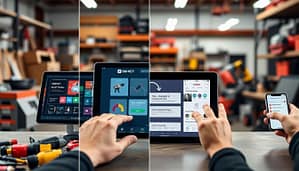
Remember when IoT was just about a fridge ordering milk? Now, it’s about tools like the Bosch 18V 360º Connected Green-Beam Laser. It shows leveling guidance and shares data with your phone. This is a big change.
IoT is now the core of better productivity. Brands like WORKPRO are leading the way. Their tools offer real-time data, alerts, and even predictive diagnostics. These tools don’t just work; they talk to you.
This turns a single tool into a part of a bigger network. It’s a key tool technology advance. The goal is to make information flow smoothly from your tool to the project manager’s tablet.
App Control: Solving Problems or Adding Passwords?
Do apps really help, or do they just add more passwords to remember? The answer is yes, they do. For precise tasks, apps are a game-changer.
Take the BLAZE Laser Measure with connected features. You can adjust settings, store measurements in the cloud, and even create simple sketches. This saves time and reduces errors. That’s a win.
But when an app is just a manual or a basic remote, it’s a waste. The best apps are easy to use and solve real problems. Anything else is just extra.
Performance Tracking & Diagnostics: The Tool That Tattles
Smart tools are getting really smart. They track things like runtime, motor temperature, and vibration patterns. This data is not just for show.
It helps tools predict problems before they happen. Imagine your angle grinder sending a message: “Motor brush wear at 85%. Schedule service next week.” This makes maintenance better.
For fleet managers, this is a big deal. You can see the health of every tool on site. It’s a big step in power tool innovations, moving from guesswork to data-driven management.
Digital Theft Protection: Security or Theater?
Now, let’s talk about the “snitch” part. Many tools now have digital theft protection. They can only work if they’re authenticated through an app.
Is it effective? Yes, against casual theft. But against serious thieves? It’s not foolproof. It’s a strong warning, not a safe.
This feature shows the two sides of smart tools. They protect your tools while also tracking them. It’s a balance between security and simplicity that each user must decide on.
The integration of smart features marks a new frontier in power tool innovations. They’re becoming part of a connected system. The value isn’t in any single connection, but in the overall intelligence they bring to the jobsite. The tools are getting smarter. The question is, are we ready to use them fully?
Performance Testing Methodology
We’re diving into the real science of tool testing, where promises meet performance. For those looking at professional grade tools, it’s the method that matters most. It’s the line between a showpiece and a reliable workhorse.
So, how do we tell fantasy from reality in tool testing? Let’s put on our detective hats and look at the three key parts of a fair test.
Standardized Testing Protocols: The Sterile Ballet
Every big brand has a lab. In these places, tools perform in a perfect world—measured cuts on clean wood, repeated drives in uniform material. These tests are key. They give us data on torque, RPM, and runtime in perfect conditions.
But, a lab is not the real world. It lacks the real challenges of a job site. Standard tests give us a starting point, but they often ignore the real-world variables. They show what a tool can do, not what it will do in real situations.
Real-World Job Site Conditions: The Crucible of Truth
This is where tools face real challenges. Real-world testing takes tools from the lab to the job site. We’re talking about framing in hot weather, cutting wet wood, and driving lag bolts into hard beams.
This method tests the things that can’t be measured. How does the tool handle long-term vibration? Does it save screw heads on repeated drives? Does it handle dust well?

This approach checks the big claims we see. When a cordless chainsaw is said to be as powerful as an 80cc gas saw, it’s tested here. It’s the only way to see if a tool is truly durable and easy to use.
Comparative Benchmarks: The Head-to-Head
Testing alone is not enough. A tool’s value is shown by how it compares to others. Benchmarking compares new tool technology advances to the best and the old.
This isn’t about finding a single winner. It’s about understanding the field. Does a new drill drive faster, but is another better for overhead work? Is a more expensive motor worth it?
We look for benchmarks that matter to professionals. We consider total cost, speed on tasks, and reliability under heavy use. For example, saying a blower is better than most gas blowers is a strong claim. But a good benchmark will show which gas models, in what conditions, and for how long. The future of this analysis is moving towards modern tools and real-time data, giving us even more insights.
In the end, a good method doesn’t just test tools. It tests promises against reality. It helps you see through the marketing and choose what really works on the job.
Brand-by-Brand Launch Analysis
Looking at the latest power tools is more about understanding strategy than just specs. Is that new brushless motor a real step forward, or just marketing hype? We’re moving beyond just cheering for our favorite brands to really analyze their moves. Each big player has made their 2025 move. Let’s see who’s aiming for checkmate and who’s just trying not to lose.
DeWalt: The Torque Contender
DeWalt came in swinging a big, yellow stick. Their focus is on pure power for the professional who doesn’t back down. The highlight is their 60V MAX Brush Cutter. This tool is not for trimming; it’s for tearing up landscapes.
DeWalt’s strategy is clear: win the brushless battle with brute force. They believe contractors will pay more for a tool that doesn’t slow down. It’s a no-holds-barred approach. They’re targeting users who value speed over saving money upfront.
Milwaukee: Fueling the Ecosystem
Milwaukee’s M18 FUEL isn’t just batteries; it’s a whole ecosystem. Their 2025 plan is to grow this ecosystem into new cordless areas. The M18 FUEL Edger is a great example. They made a tool that was once gas or corded wireless, without losing power.
Milwaukee’s goal is to keep users in their ecosystem. Once you’re in, every new tool is easier to buy. It’s a smart, long-term strategy. For those with lots of M18 batteries, it’s not an expense but a smart addition.
Makita: The Quiet Strategist?
While others focus on torque, Makita plays a quieter game. Their 2025 releases focus on quality and ergonomics, not just power. Have they been overlooked in the marketing battle? Or are they avoiding a power war they can’t win?
Makita seems to target professionals who value balance, durability, and comfort. It’s a different kind of value. They might seem conservative, but they could win loyalty from users who see tools as partners, not disposable items.
Bosch & The Broader Field: Ambition vs. Value
Bosch is announcing 60 new products for 2025. This is either a bold move or a sign of overconfidence. They’re diving into concrete tech and expanding their 18V outdoor line. It’s a big push into many areas, relying on trust and German engineering to gain share.
Outside the big names, things get interesting. Greenworks is going after pros with its H.O.G. line, like the chainsaw and blower. Husqvarna’s 590BTS blower brings serious commercial power to battery tools.
Brands like WORKPRO are focusing on value with their 2025 ErgoGrip line. Senix, Ryobi, and even Kubota are also making moves. It’s not just a two-horse race anymore. It’s a battle for every wallet and workflow.
To understand the battlefield, here’s a tactical breakdown of the key players and their 2025 moves:
| Brand | Key 2025 Release | Notable Feature | Target User | Price Positioning |
|---|---|---|---|---|
| DeWalt | 60V MAX Brush Cutter | Extreme brushless power, high-torque application | Landscaping/Construction Pro | Premium (High investment, high return) |
| Milwaukee | M18 FUEL Edger | Cordless conversion of a corded/gas tool, ecosystem integration | Professional invested in M18 platform | High (Ecosystem value justifies cost) |
| Makita | Refined Drill/Driver Series | Ergonomic focus, durability, balanced performance | Quality-focused Pro & Serious DIYer | Competitive Premium (Value over raw power) |
| Bosch | 18V Concrete & Outdoor Range | Wide category expansion (60+ new tools pledged) | Industrial & Advanced DIY | Varied (From mid-range to professional tier) |
The table shows the main strategies. DeWalt and Milwaukee are in a power-and-platform battle for professional loyalty. Makita offers a different path. Bosch is trying to take a big chunk of the market. For the smart buyer, understanding these strategies is more important than any single spec. The right tool depends on which strategy matches your needs.
Professional User Feedback
Forget the fancy specs and press releases. The real story of 2025’s power tools is told in sawdust and sweat on job sites. Marketing promises are nice, but paying rent is better. This section looks at how these tools really perform, based on feedback from those who use them to make a living.
We’ve dug through early reviews, contractor testimonials, and performance data. Our aim is to find the professional grade tools from the ones that won’t last.
Early Adopter Reviews: The First Signal
Early users are like the canary in the coal mine for the industry. Their feedback is a mix of excitement and honesty. It tells us if a new battery platform is a game-changer or just a heavier power pack.
From the field, it’s clear that new lithium batteries are getting praise. They last a full shift. Fast-charging innovations are also a hit, cutting down on downtime. One review said, “It changes how you plan the day. You’re not babysitting chargers anymore.”
Contractor Testimonials: The Daily Grind
Contractor testimonials cut through the noise. These aren’t hobbyists. Their feedback is based on real, demanding use. A common theme is tools that go beyond corded power. Framers and metalworkers say there’s no drop in performance, which is a big win.
Smart integration is a mixed bag. App-based diagnostics save time for fleet managers. But, complex Bluetooth pairing or tracking that feels like micromanagement gets a thumbs down. As one electrician said, “I need a drill that works, not one that needs a software update.”
Job Site Performance Data: The Hard Numbers
Aggregated job site performance data tells a compelling story. Metrics like mean time between failures, battery cycle counts, and durability in extreme temperatures are tracked by larger crews.
This data backs up many of the 2025 claims. Tools made with new materials show less wear in high-vibration applications. The power output of new cordless tools often meets or exceeds their corded counterparts. This isn’t lab data. It’s proof earned board by board.
| Tool Category | Brand (2025 Model) | Early Verdict from Pros | Noted Job-Site Win |
|---|---|---|---|
| Brushless Impact Driver | Milwaukee M18 FUEL | “Unmatched torque control for delicate fasteners.” | Reduced stripped screws on cabinetry. |
| Cordless Table Saw | DeWalt FlexVolt | “Finaly, site-ready cordless rip power.” | Enables work in off-grid new constructions. |
| Smart Oscillating Tool | Makita XGT | “App-based blade selection is a genuine time-saver.” | Faster material-specific setting changes. |
| High-Capacity Charger | Bosch 18V | “Cuts battery swap downtime in half.” | Keeps 4-person crew fully powered. |
The table above shows a trend. The most celebrated power tool innovations solve real, daily problems. Feedback focuses on workflow integration and trust, not just specs.
In the end, professional user feedback is the ultimate filter. It shows which advancements are meaningful and which are just marketing. For anyone looking to invest in this year’s tools, this feedback is invaluable.
Investment Worthiness Assessment
We’re about to examine the 2025 tool launches closely. We’ll look at ROI, productivity gains, and the cost of cordless envy. Is this year’s tools a smart business choice or a budget-buster? Let’s use our financial calculators to find out.
Forget about brand loyalty for now. Every tool is a capital asset in your business. Its value is in the work it does, not its looks. The key question for any cordless tool update is: will it pay for itself?
Upgrade Necessity Evaluation
Not all upgrades are the same. You need to be honest with your current tools. Is your old drill slow, costing you 15 minutes per task for a five-person crew? That’s lost time.
Think about the numbers. A $229 Ryobi blower might be a must for landscapers with old gas models. A $1,267 Greenworks chainsaw is essential if gas tools are banned. But a $549 Milwaukee edger is harder to justify unless your current one is a big problem.
The key is often the ecosystem. A 20% runtime boost with a new battery platform is attractive. But if it means getting rid of ten good batteries and chargers, it’s expensive. This is where tool technology advances meet sunk costs.
ROI Calculations: Running the Numbers
Return on investment is just math. First, figure out the time savings. If a new fast-charging system saves 30 minutes of downtime per day, multiply that by your labor rate.
Second, consider the upfront costs. A $600 tool might seem expensive. But if it saves you $1,500 on repairs or avoids hiring a subcontractor, it’s worth it.
Here’s a basic comparison for common 2025 upgrade scenarios:
| Tool Scenario | Upfront Cost | Key Benefit | Estimated Payback Period |
|---|---|---|---|
| Upgrading 5 old corded saws to new cordless | ~$2,500 | Eliminate cords, setup time; increase mobility | 1-2 major jobs |
| Replacing 10 old batteries with new high-capacity ones | ~$1,800 | 30% longer runtime, less battery swaps | One season for a busy crew |
| Adding one “game-changer” tool (e.g., new modular system) | ~$550 | Replaces 2-3 single-function tools | Project-dependent, but space savings are instant |
The power tools market growth is driven by promises of productivity. Your job is to see if these promises come true on your job site.
Fleet Replacement Strategies
You don’t have to replace everything at once. A smart strategy is phased and tactical.
The Critical Path Method: Replace tools that fail on critical, revenue-generating tasks first. The drill that dies mid-installation gets priority over the backup grinder.
The Ecosystem Leap: If you’re committing to a new battery platform, plan a 12-18 month transition. Buy new tools in that system as old ones wear out, using adapters as a bridge. This spreads the cost.
The Augmentation Play: Sometimes, buying one incredible new tool is better than replacing three mediocre ones. A powerful new cordless mixer might handle tasks you used to rent equipment for, creating immediate ROI.
Every cordless tool update should be questioned. Does it solve a real problem? Does it open up new revenue streams? Or is it just a slightly shinier version of what you already have? The 2025 lineup is full of possibilities, but your wallet—and your business—demand a careful look.
Availability & Pricing Timeline
The real excitement is in the release dates and prices, not the flashy demos. The confetti has settled, and the marketing buzz has faded fast. Now, we’re left wondering when and how much we’ll pay.
This section is your guide. We’re tracking the journey from promise to purchase. Which latest power tools will you buy next, and which are delayed?
Release Schedules: From Imminent to “See You in 2026”
Manufacturer timelines are often overly optimistic. Some brands ship quickly after announcing. Others take a longer time.
Bosch, for example, says their prototypes will launch in 2026. That’s a long wait. Plan ahead.
On the other hand, tools from DeWalt, Milwaukee, and Makita are already in stores. If it was shown working at the show, it’s likely to arrive in 6 months. If it was just a demo, be patient.
Pre-Order Opportunities: Strategic Gambles
Should you pre-order or wait? It’s a big decision for tool lovers. The answer depends on the brand’s history and supply chain rumors.
Special edition kits or tools with new tech often have limited supply. Getting one early can give you a head start. But, there’s a risk of delays.
Our advice? Pre-order only for tools that are really important. For others, waiting might get you a better deal.
Street Price Predictions: The Art of the Deal
The MSRP is just the starting point. The final price is what really matters. Let’s predict the future.
Tools with lots of competition see prices drop by 15-20% in 90 days. Special tools hold their value longer. Black Friday sales can slash prices even more.
Will that $549 tool be cheaper by fall? Yes, it probably will. But, will that $20,799 specialty tool ever go on sale? Don’t count on it.
Here’s what we expect for some latest power tools:
| Tool / Brand | Announced MSRP | Street Price Prediction (Within 6 Months) | Release Window |
|---|---|---|---|
| DeWalt High-Power Station | $3,000 | $2,700 – $2,850 | Q3 2025 |
| Milwaukee Ultra-Duty Rig | $20,799 | $20,000 – $20,500 | Q4 2025 / Q1 2026 |
| Makita Precision Combo Kit | $890 | $750 – $800 | Available Now |
| Bosch Smart Router System | $799 | $720 (Late 2026) | 2026 |
| Compact Brushless Drill (Various) | $229 | $179 – $199 | Q2 2025 |
| High-Capacity Vacuum | $689 | $620 – $650 | Q3 2025 |
The table shows that high-demand items often get cheaper. But, the high-end tools? Their prices are set in stone.
So, what’s the best move? For the soon-to-be-released new tool releases 2025, waiting a quarter is wise. For the rare, 2026 tools, maybe just admire them for now. Your wallet and schedule will thank you for waiting.
Conclusion: Top 5 Must-Watch Releases
After a year of testing and analysis, the top 2025 releases are clear. These five tools have truly made a difference. They set the pace for the latest power tools.
Greenworks’ new 80V platform is more than just a battery. It’s a game-changer, making gas tools obsolete for professionals. This innovation means no more running out of power during long days.
Milwaukee’s MX Fuel Cut-Off Saw is a major breakthrough. It’s the first to cut the cord for good. This tool shows what’s possible without being tied down.
DeWalt’s PowerStack Connect drill is a smart tool. It logs torque through an app, turning guesses into facts. This shift shows the future of professional tools.
Bosch’s 18V Brushless Rotary Hammer packs a punch in a small package. Its performance is a lesson in tool technology.
Makita’s XGT 40V Finish Nailer is a steal. It fires perfectly and is priced to beat the competition. Upgrading now is a smart choice.
These 2025 tool releases show us power, smarts, and great value. Your future toolbox is being shaped now. These are the tools to bet on.